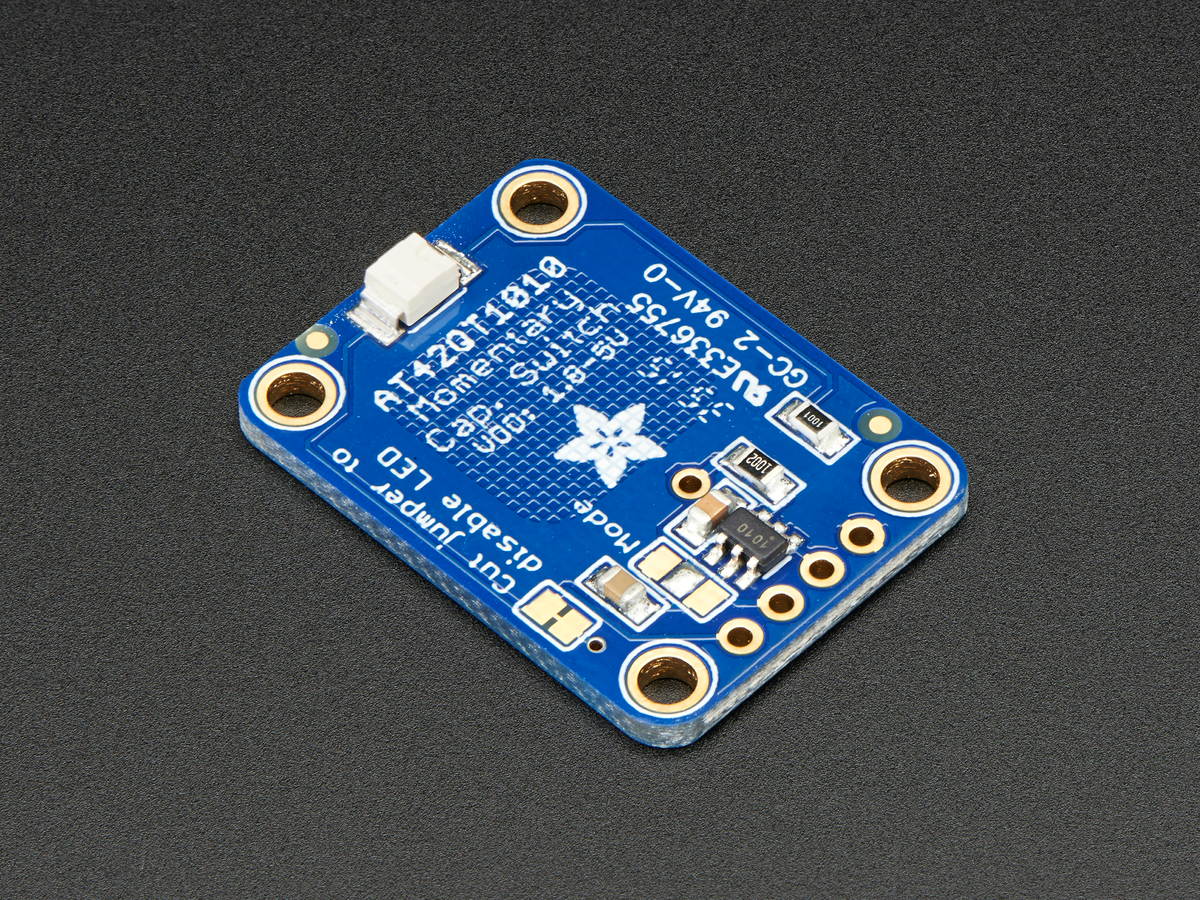
Adafruit Standalone Momentary Capacitive Touch Sensor Breakout
Key Features: Single "momentary" capacitive touch sensor Red LED indicator when touched Save power by disconnecting the LED from the output pin Designed with the more-responsive "fast mode" This breakout board is the simplest way to create a project with a single "momentary" capacitive touch sensor. Just power with 1.8 to 5.5VDC and touch the pad to activate the sensor. When a capacitive load is detected (e. g. a person touches the sensor-pad area) the red LED lights up and the output pin goes high. You can also solder a wire to the middle pad and create your own capacitive pad if the built-in one isn & #39; t suited to your project. If you want to save power, the LED can be disconnected from the output pin (cut the trace between the jumper marked as such). Designed with the more-responsive "fast mode", it draws about 0.5 mA. If you need ultra-low (~50uA) power usage, the mode jumper can be cut on one side & soldered closed on the other to fix it into that mode. Check Adafruit & #39; s datasheet for specific power usage measurements. Item Specifics Size: 20mm / 0.8" x 28mm / 1.1" Weight: 1.87 g
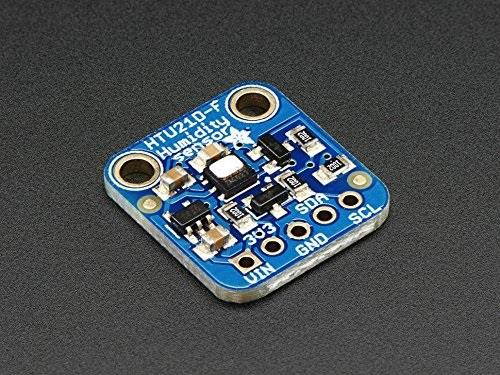
adafruit htu21df temperature & humidity sensor breakout board ada1899
It's summer and you're sweating and your hair's all frizzy and all you really want to know is why the weatherman said this morning that today's relative humidity would max out at a perfectly reasonable 52% when it feels more like 77%. Enter the HTU21D-F Temperature + Humidity Sensor - the best way to prove the weatherman wrong! This I2C digital humidity sensor is an accurate and intelligent alternative to the much simpler Humidity and Temperature Sensor - SHT15 Breakout It has a typical accuracy of 2% with an operating range that's optimized from 5% to 95% RH. Operation outside this range is still possible - just the accuracy might drop a bit. The temperature output has an accuracy of 1C from -30~90C. If you're looking to measure temperature more accurately, we recommend the MCP9808 High Accuracy I2C Temperature Sensor Breakout Board. Such a lovely chip - so we spun up a breakout board that includes the Filtered version (the white bit of plastic which is a PTFE filter to keep the sensor clean), a 3.3V regulator and I2C level shifting circuitry. This lets you use it safely with any kind of microcontroller with 3.3V-5V power or logic. Each order comes with one fully assembled and tested PCB breakout and a small piece of header. You'll need to solder the header onto the PCB but it's fairly easy and takes only a few minutes even for a beginner.UPC NO:701980281617 SKU:ADIB00OKJFLWO
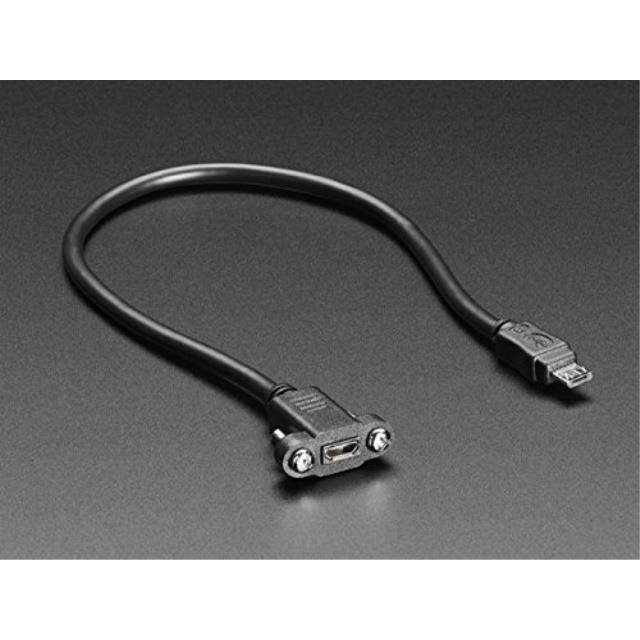
adafruit panel mount extension usb cable micro b male to micro b female ada3258
Check out this handy MicroUSB extension cable, which will make it easy for you to enclose a device that has a Btype (micro USB host) port. Great if you need to extend the USB port for your Raspberry Pi, Arduino, Feather or really anything development board. This Micro-B male/female extension cable features a male USB Micro-B plug on one end, and a bulkhead mountable Micro-B female receptacle on the other. The jack half has two mounting 'ears' with 4-40 screws installed, 18mm apart. The ears are flexible so the holes don't have to be drilled very precisely. The screws can be put on from the back for 'reverse' mounting if the box thickness is a problem. The entire unit is about 12" long from tip to tip (with approx 10" cabling between connectors). Rated for high-speed USB 2.0 use. Features: Embedded 4-40 screws (no threading required) Mounting screws includedWired straight throughUSB 2.0 compatible UPC NO: 604776613282 SKU: ADIB0718XQPGB
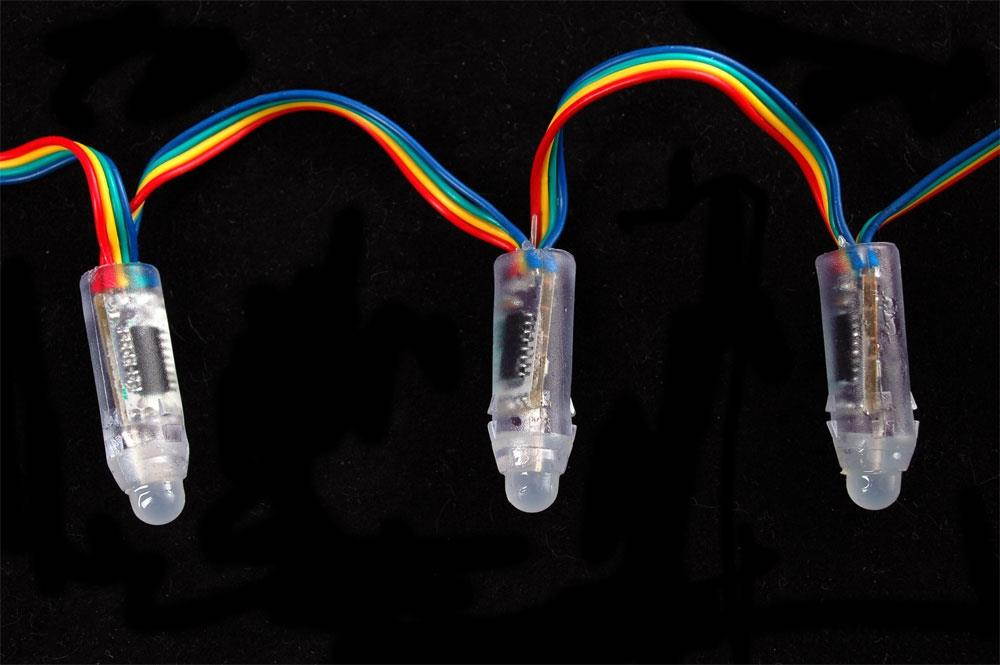
12mm Diffused Thin Digital RGB LED Pixels (Strand of 25)(WS2801)
RGB Pixels are digitally-controllable lights you can set to any color, or animate. Each RGB LED and controller chip is molded into a 'dot' of silicone. The dots are weatherproof and rugged. There are four flanges molded in so that you can 'push' them into a 12mm drill hole in any material up to 1.5mm/0.06" thick. They're typically used to make outdoor signs. We also have flat-backed pixels that are essentially the same, but are not as long and thin.The pixels are connected by a 4-conductor cable. +5V (Red), Ground (Blue), Data (Yellow) and Clock (Green). Data is shifted down from one pixel to the next so that you can easily cut the strand or attach more onto the end.Each dot is digitally controlled, with an internal 8-bit PWM LED driver (24-bit color for 16 million different shades). The pixels must be clocked by a microcontroller, we have an example code linked below that works on an Arduino, it should be simple to adapt it to any other microcontroller.The pixels use 8mm diffused RGB LEDs, with a 120 degree beam width. The total max brightness of all LEDs is about 1600mcd but with the light more evenly distributed & mixed than a clear LED. (Please note: mcd ratings of LEDs are notoriously inflated by most LED sellers, so be extra-skeptical when reviewing LED ratings!)Sold by the strand, each strand has 25 pixels in series! Each strand has two JST SM 4-pin connectors so you can connect multiple strands in a row, as many as you wish, just watch for how much current they want. We now have LED pixel strands with the power wires (red & blue) spliced out so its really easy to connect 5VDC in using a 2.1mm jack terminal adapter. We have a 5V/2A supply that should be able to drive 2 or more strands and a 5V/10A supply that can drive up to 160 LEDs all lit up at onceIf you want to connect to the input of a strand (to wire it to power and a microcontroller) please get a receptacle connector. If you want to connect to the output, get a plug cable.You can drive these with an Arduino using any two microcontroller digital pins, check this library which also has example code to demonstrate the strands and be sure to read our very detailed tutorial on usage!Technical Details: 12mm diameter (0.45") 75mm deep (1.5") 80mm / 3" apart on the strand 25 pieces per strand New! These pixels use a WS2801 chip for full 24 bit color 5V power, 60mA maximum per pixel (LED on full white) 2-pin SPI-like protocol WS2801 Datasheet for the chip inside each pixel Brightness: Red = 3.3 Lumens/300 mcd, Green = 10 Lumens/1000 mcd, Blue = 2.7 Lumens/300 mcd (mcd calculation based on full 120 degree beam)
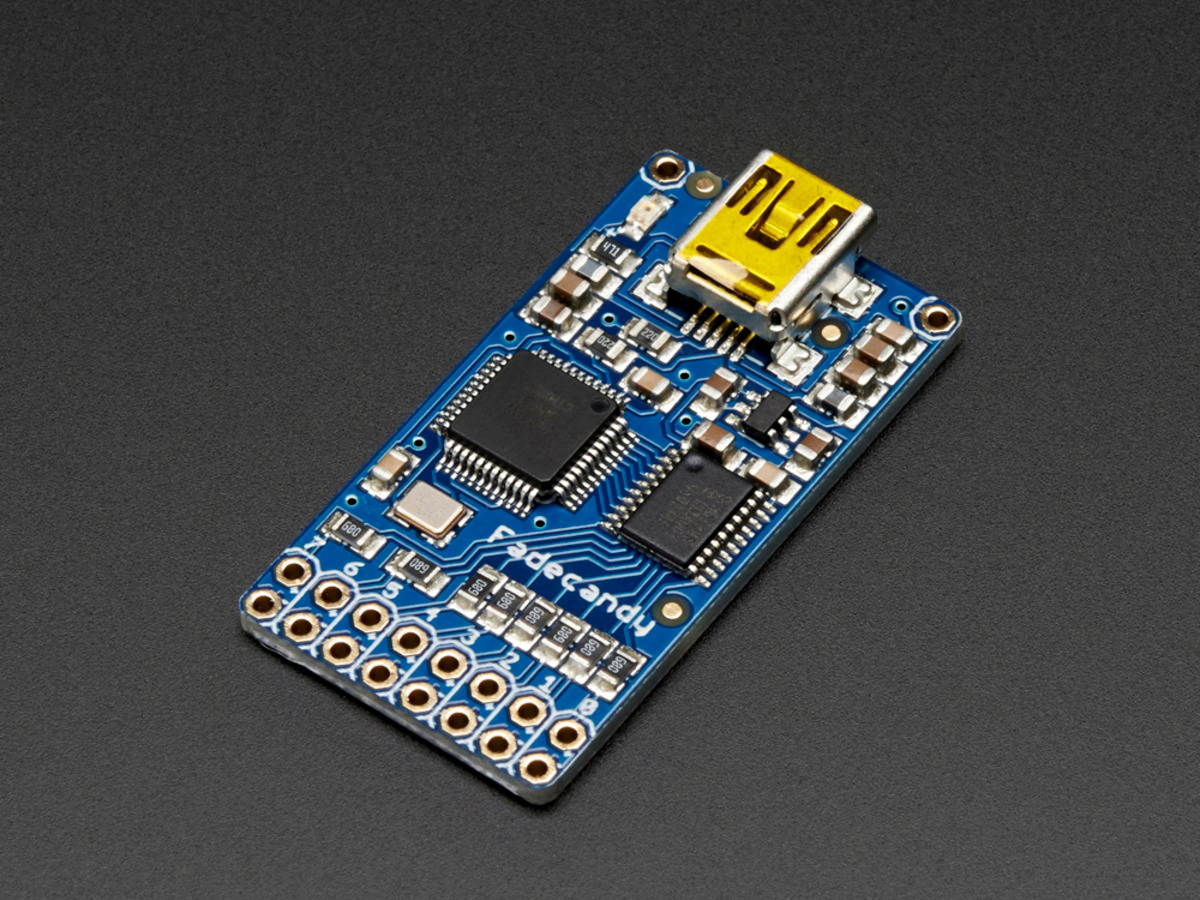
Adafruit FadeCandy - Dithering USB-Controlled Driver for NeoPixels
A new collaboration between Adafruit & Micah from Scanlime, we are excited to introduce Fadecandy, a NeoPixel driver with built in dithering, that can be controlled over USB. Fadecandy is not just hardware! It is a kit of both hardware and software parts that make LED art projects easier to build and better-looking so sculptors and makers and multimedia artists can concentrate on beautiful things instead of reinventing the wheel. It's an easy way to get started and an advanced tool for professionals. It's a collection of simple parts that work well together: Firmware that uses unique dithering and color correction algorithms to raise the bar for quality while getting out of the way of your creativity. Open source hardware for connecting cheap and popular WS2811 based LEDs to a laptop, desktop, or Raspberry Pi over USB. Fadecandy Server Software, which communicates with one Fadecandy board or dozens. It runs on Windows, Linux, and Mac OS, and on embedded platforms like Raspberry Pi. The Open Pixel Control protocol, a simple way of getting pixel data from your creative tools into the Fadecandy server. Libraries and examples for popular languages. We have Python and Processing already, with Javascript and Max coming soon. LEDs! Fadecandy works with Adafruit's popular WS2811/WS2812 LEDs. Each controller board supports up to 512 LEDs, arranged as 8 strips of 64 each. Headers are not included but we have tons of different kinds of dual header in the shop if you want to solder something into the pads. Fadecandy is designed to enable art that is subtle, interactive, and playful - exploring the interplay between light, form, and shadow. If you’re tired of seeing project after project with frenetic blinky rainbow fades, you’ll appreciate how easy it is to create expressive lighting! It's also battle tested! The firmware was originally developed to run the Ardent Mobile Cloud Platform, a Burning Man project which used 2500 LEDs to project ever-changing rolling cloud patterns onto the interior of a translucent plastic sculpture. It used five Fadecandy boards, a single Raspberry Pi, and the effects were written in a mixture of C and Python. The lighting on this project blew people away, and it made me realize just how much potential there is for creative lighting, but it takes significant technical drudgery to get beyond frenetic-rainbow-fade into territory where the lighting can really add to an art piece instead of distracting from it.
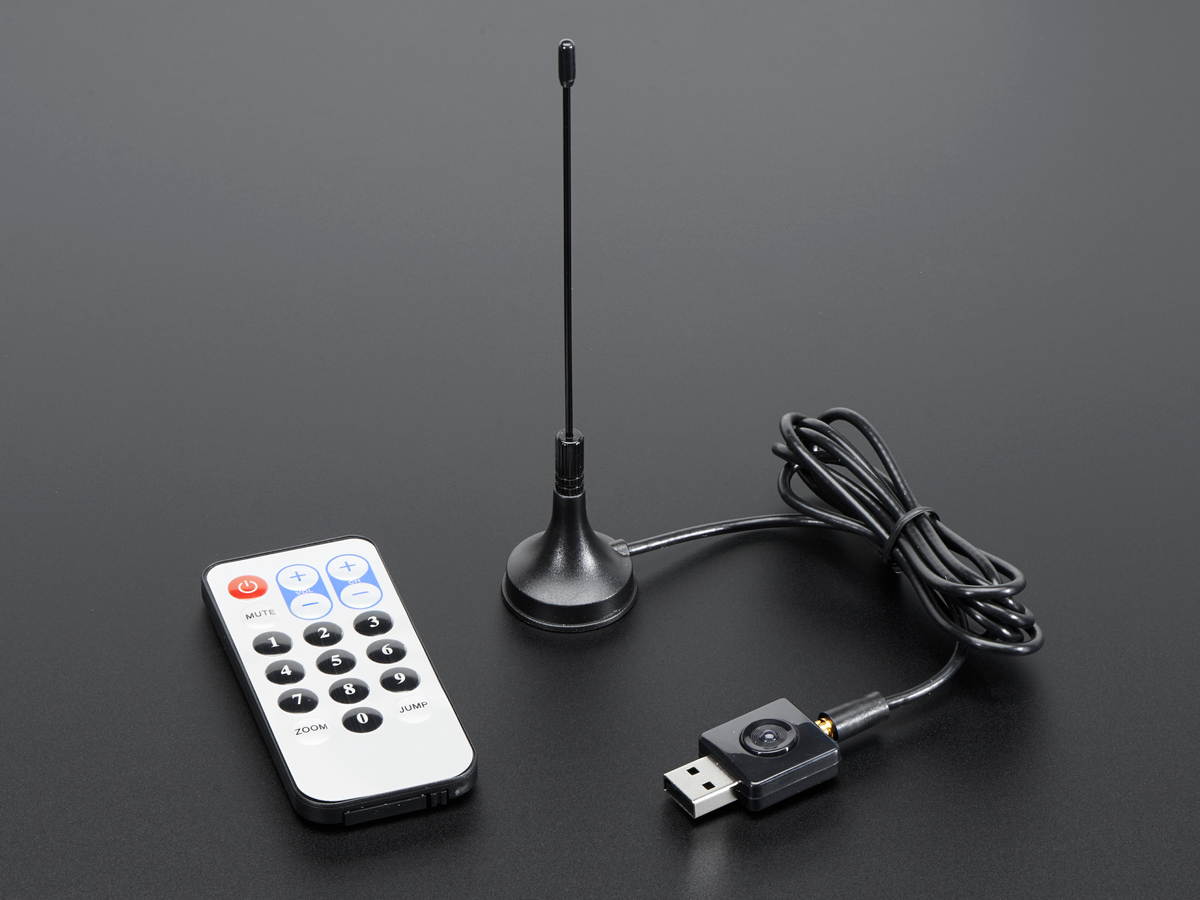
Adafruit Software Defined Radio Receiver USB Stick - RTL2832 w/R820T
Key Features: Easiest way possible to have fun with a powerful, configurable receiver Can tune into signals from 24MHz to 1850MHz Very compact (but very good quality) RTL2832+R820T module with an MCX RF connector Basic & #39; DVB-T & #39; antenna (not available in the US but will work in Europe) If you & #39; ve ever been curious about software defined radio (SDR), this USB stick is the easiest way possible to have fun with a powerful, configurable receiver. Packed with the powerful RTL2832U and R820T tuner, it can tune into signals from 24MHz to 1850MHz. That means you can use a computer (with Windows, Mac, or Linux) to tune into: FM Radio, AM signals (but not AM radio), CW (morse code! ), unencrypted radio signals (such as those used by many police and fire departments), POCSAG pagers, and more. Please note! Depending on your location, listening in to some radio signals may not be legal. So consider this your warning to check before & #39; accidentally & #39; tuning into naughty frequencies. Item Specifics Antennae Length: 120.65 mm / 4.75" Wire Length: 1168.4 mm / 46" USB Dongle: 22.24 mm x 23.1 mm x 9.9 mm / 0.87" x 0.9" x 0.38"
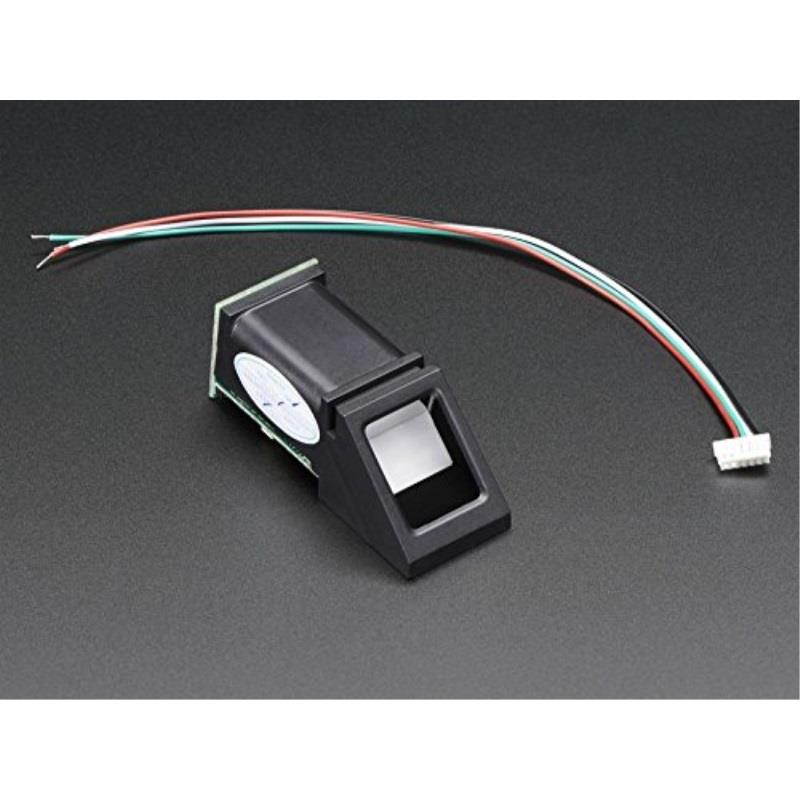
Adafruit Fingerprint sensor
Secure your project with biometrics - this all-in-one optical fingerprint sensor will make adding fingerprint detection and verification super simple. These modules are typically used in safes - there's a high powered DSP chip that does the image rendering, calculation, feature-finding and searching. Connect to any microcontroller or system with TTL serial, and send packets of data to take photos, detect prints, hash and search. You can also enroll new fingers directly - up to 162 finger prints can be stored in the onboard FLASH memory. There's a red LED in the lens that lights up during a photo so you know its working. We like this particular sensor because not only is it easy to use, it also comes with fairly straight-forward Windows software that makes testing the module simple - you can even enroll using the software and see an image of the fingerprint on your computer screen. But, of course, we wouldn't leave you a datasheet and a "good luck!" - we wrote a full Arduino library so that you can get running in under 10 minutes. The library can enroll and search so its perfect for any project . We've also written a detailed tutorial on wiring and use . This is by far the best fingerprint sensor you can get.UPC:701851954671SKU:ADIB00QSIZSOG
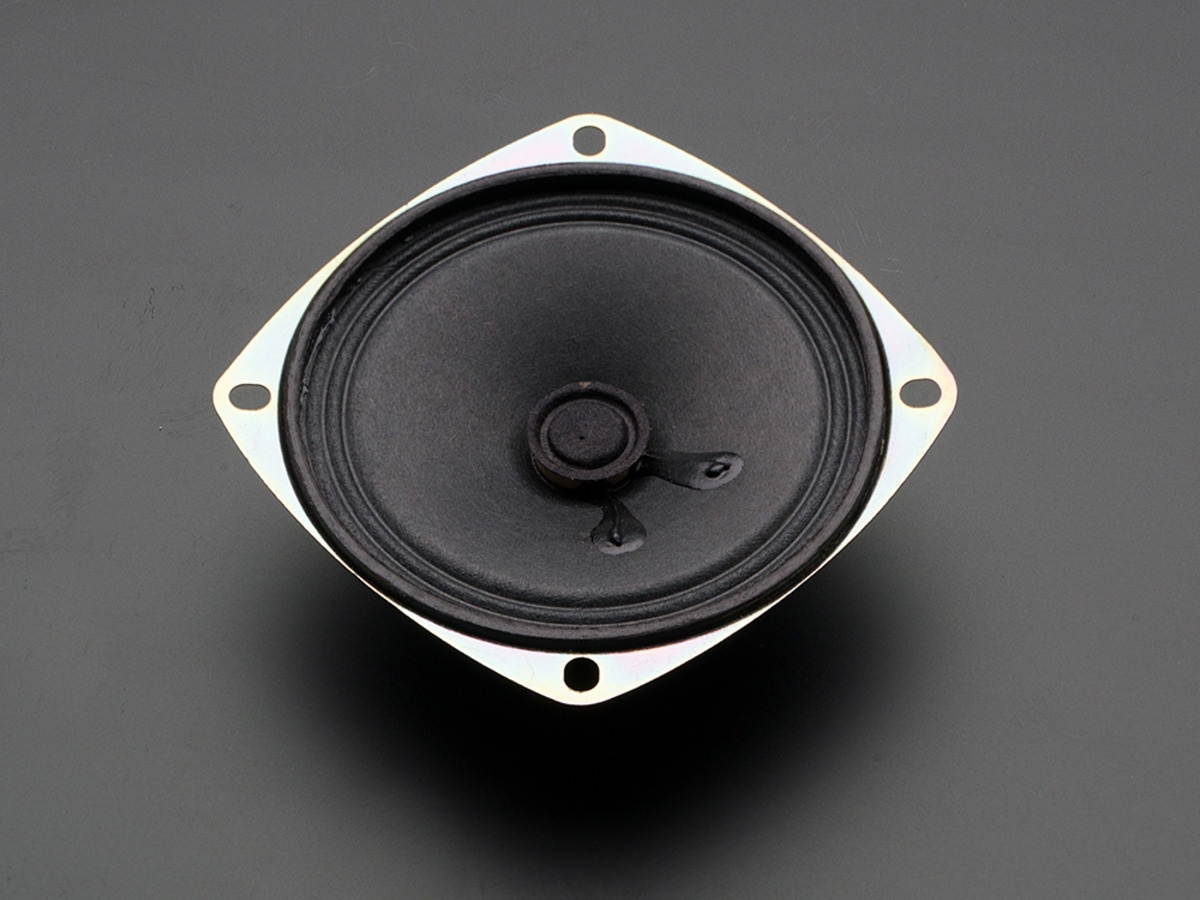
Adafruit 3" Diameter Speaker - 8 Ohm 1 Watt
Key Features: 3" Diameter speaker 1W, 8 Ohm Works great with our Wave shield or class D amplifier board. Handy mounting tabs Listen up! This 3" diameter speaker cone is the perfect addition to any audio project where you need an 8 ohm impedance and 1W or less of power. We particularly like this cone as it has 4 handy mounting tabs 60mm apart. Item Specifics Weight: 50.48 g Size: 3.06" x 3.06" x 1"
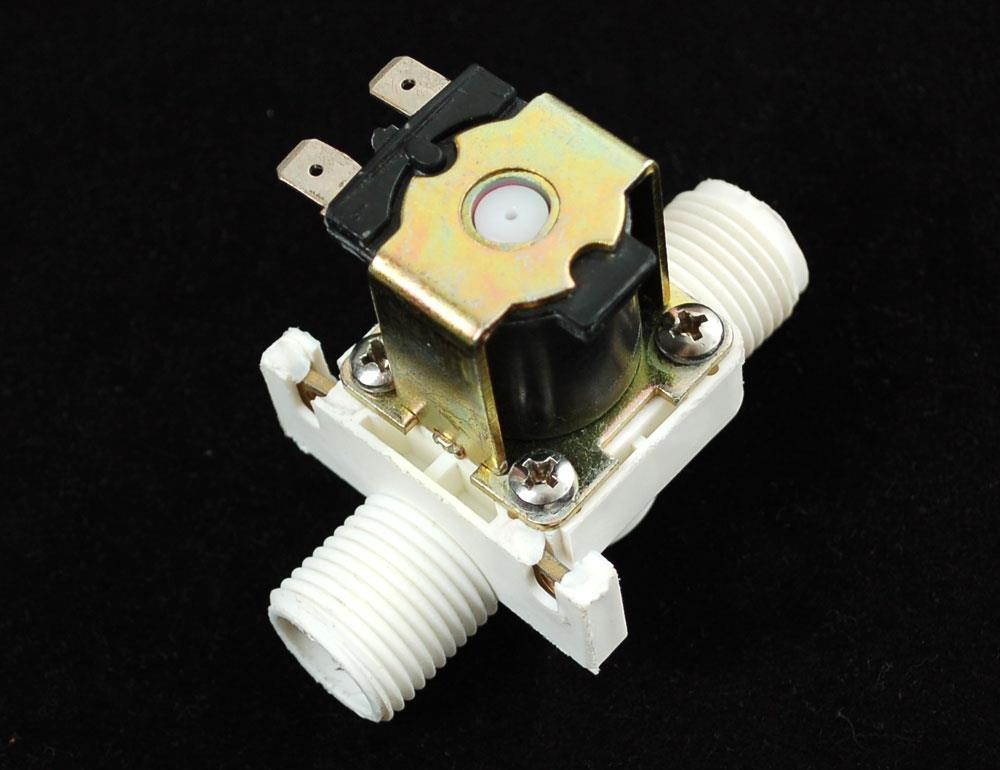
Plastic Water Solenoid Valve - 12V - 1/2 NPT
Control the flow of fluid using the flow of electrons! This liquid valve would make a great addition to your robotic gardening project. There are two 1/2" (Nominal non-taped National Pipe) outlets. Normally, the valve is closed. When 12VDC is applied to the two terminals, the valve opens and water can push through. The valve has a gasket arrangement inside, so there is a minimum pressure requirement of 0.02 Mpa (3 PSI). Also, liquid can only flow one direction. We tried this solenoid at various DC voltages and found we could actuate it down at 6VDC (although it was a little slower to open). Here is the current draw table for various voltages. We suggest a TIP120 or N-Channel power FET with a 1N4001 kickback diode to drive this from a microcontroller pin. For a power supply, our 9V 1A or 12V 1A power adapters will do the job. If you want a beefier water valve, we also carry a brass version which does not have a minimum pressure requirement and can be used with liquid flow in either direction. Voltage Current6V 160 mA7V 190 mA8V 220 mA9V 240 mA10V 270 mA11V 300 mA12V 320 mAThese solenoids are not rated for food safety or use with anything but water. Technical Details: 1/2" Nominal NPS Working Pressure: 0.02 Mpa - 0.8 Mpa Working Temperature: 1? - 75? Response time (open): = 0.15 sec Response time (close): = 0.3 sec Actuating voltage: 12VDC (but we found it would work down to 6V) Actuating life: = 50 million cycles Weight: 4.3 oz Dimensions: 3" x 2.25" x 2"
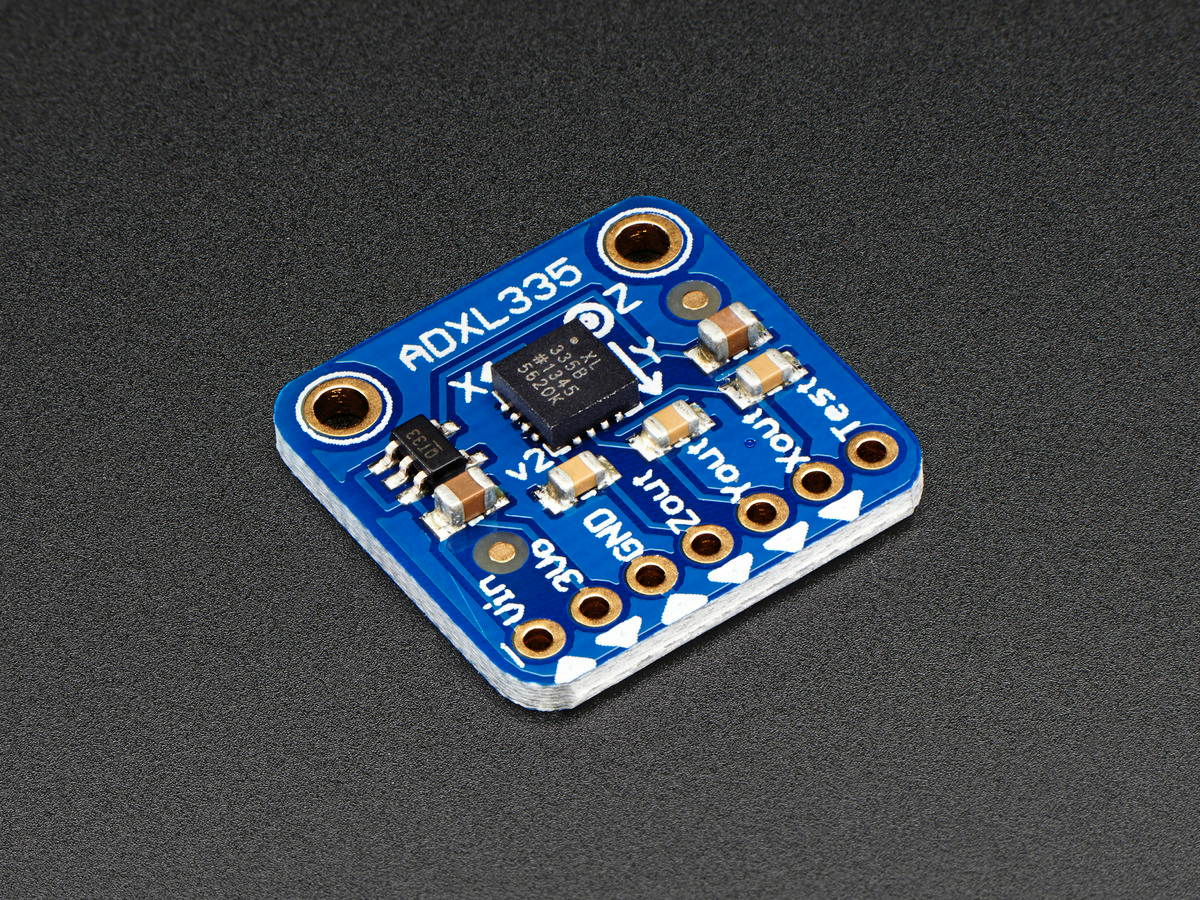
Adafruit ADXL335-5V Ready Triple-axis Accelerometer (+-3g Analog Out)
Key Features: Fully assembled and tested Comes with 8 pin 0.1" standard header Two 2mm ( 0.08" ) mounting holes for easy attachment. The XYZ filter capacitors are 0.1 uF for a 50 Hz bandwidth Your favorite triple-axis accelerometer has been updated to now have an on-board 3.3V regulator - making it a perfect choice for interfacing with a 5V microcontroller such as the Arduino. This breakout comes with 3 analog outputs for X, Y and Z axis measurements on a 0.75" x 0.75" breakout board. The ADXL335 is the latest and greatest from Analog Devices, known for their exceptional quality MEMS devices. The VCC takes up to 5V in and regulates it to 3.3V with an output pin. The analog outputs are ratiometric: that means that 0g measurement output is always at half of the 3.3V output ( 1.65V ), -3g is at 0v and 3g is at 3.3V with full scaling in between. Item Specifics Board size: 0.75" x 0.75" Mounting hole size: 2 mm VCC voltage: up to 5V Analog Outputs: Ratiometric XYZ Filter Capacitors: 0.1 uF for a 50 Hz bandwidth Fully Assembled
RF Development Tools Adafruit Feather 32u4 RFM69HCW Packet Radio - 868 / 915 MHz
- This is the Adafruit Feather 32u4 Radio (RFM69HCW) 900MHz - our take on an microcontroller packet radio transceiver with built in USB and battery charging. Its an Adafruit Feather 32u4 with a 900 MHz radio module cooked in! Great for making wireless networks that can go further than 2.4GH z 802.15. 4 and similar, are more flexible than Bluetooth LE and without the high power requirements of WiFi. We have other boards in the Feather family, check'em out here. This is the 900 MHz radio version, which can be used for either 868MHz or 915MHz transmission/reception - the exact radio frequency is determined when you load the software since it can be tuned around dynamically. We also sell a 433MHz version of the same radio chipset and if you want much longer range, check out the LoRa 900MHz Feather At the Feather 32u4's heart is at ATmega32u4 clocked at 8 MHz and at 3.3V logic, a chip setup we've had tons of experience with as it's the same as the Flora. This chip has 32K of flash and 2K of RAM, with built in USB so not only does it have a USB-to-Serial program & debug capability built in with no need for an FTDI-like chip, it can also act like a mouse, keyboard, USB MIDI device, etc. To make it easy to use for portable projects, we added a connector for any of our 3.7V Lithium polymer batteries and built in battery charging. You don't need a battery, it will run just fine straight from the micro USB connector. But, if you do have a battery, you can take it on the go, then plug in the USB to recharge. The Feather will automatically switch over to USB power when its available. We also tied the battery thru a divider to an analog pin, so you can measure and monitor the battery voltage to detect when you need a recharge.
Adafruit Bluefruit LE SPI Friend - Bluetooth Low Energy (BLE)
Would you like to add powerful and easy-to-use Bluetooth Low Energy to your robot, art or other electronics project? Heck yeah! With BLE now included in modern smart phones and tablets, its fun to add wireless connectivity. So what you really need is the new Adafruit Bluefruit LE SPI Friend! The Bluefruit LE SPI Friend makes it easy to add Bluetooth Low Energy connectivity to anything with 4 or 5 GPIO pins. With SPI, you don't have to worry about baud rates, flow control, or giving up a hardware UART port. Connect to your Arduino or other microcontroller using the common four-pin SPI interface (MISO, MOSI, SCK and CS) plus a 5th GPIO pin for interrupts (to let the Arduino know when data or a response is ready). If you like Serial communication more than SPI, we also have a version that can talk UART The board is capable of much more than just sending strings over the air! Thanks to an easy to learn AT command set, you have full control over how the device behaves, including the ability to define and manipulate your own GATT Services and Characteristics, or change the way that the device advertises itself for other Bluetooth Low Energy devices to see. You can also use the AT commands to query the die temperature, check the battery voltage, and more, check the connection RSSI or MAC address, and tons more. Really, way too long to list here! Download our free Android/iOS app and you're ready to rock! Using our Bluefruit iOS App or Android App, you can quickly get your project prototyped by using your iOS or Android phone/tablet as a controller. We have a color picker, quaternion/accelerometer/gyro/magnetometer or location (GPS), and an 8-button control game pad.UPC:717520029113SKU:ADIB01F3U8V0W
ADAFRUIT INDUSTRIES 1141 DATA LOGGING SHIELD BOARD, ARDUINO
Core Architecture:-.Core Architecture:-.Core Sub-Architecture:-.Core Sub-Architecture:-.For Use With:Arduino UNO, Duemilanove, Diecimila, Leonardo or ADK / Mega R3 or Higher.For Use With:Arduino UNO, D.Kit Contents:Data Logging Shield Board.Kit Contents:Data Logging S.SVHC:To Be Advised.Silicon Core Number:-.Silicon Core Number:-.Silicon Family Name:-.Silicon Family Name:-.Silicon Manufacturer:-.Silicon Manufacturer:-

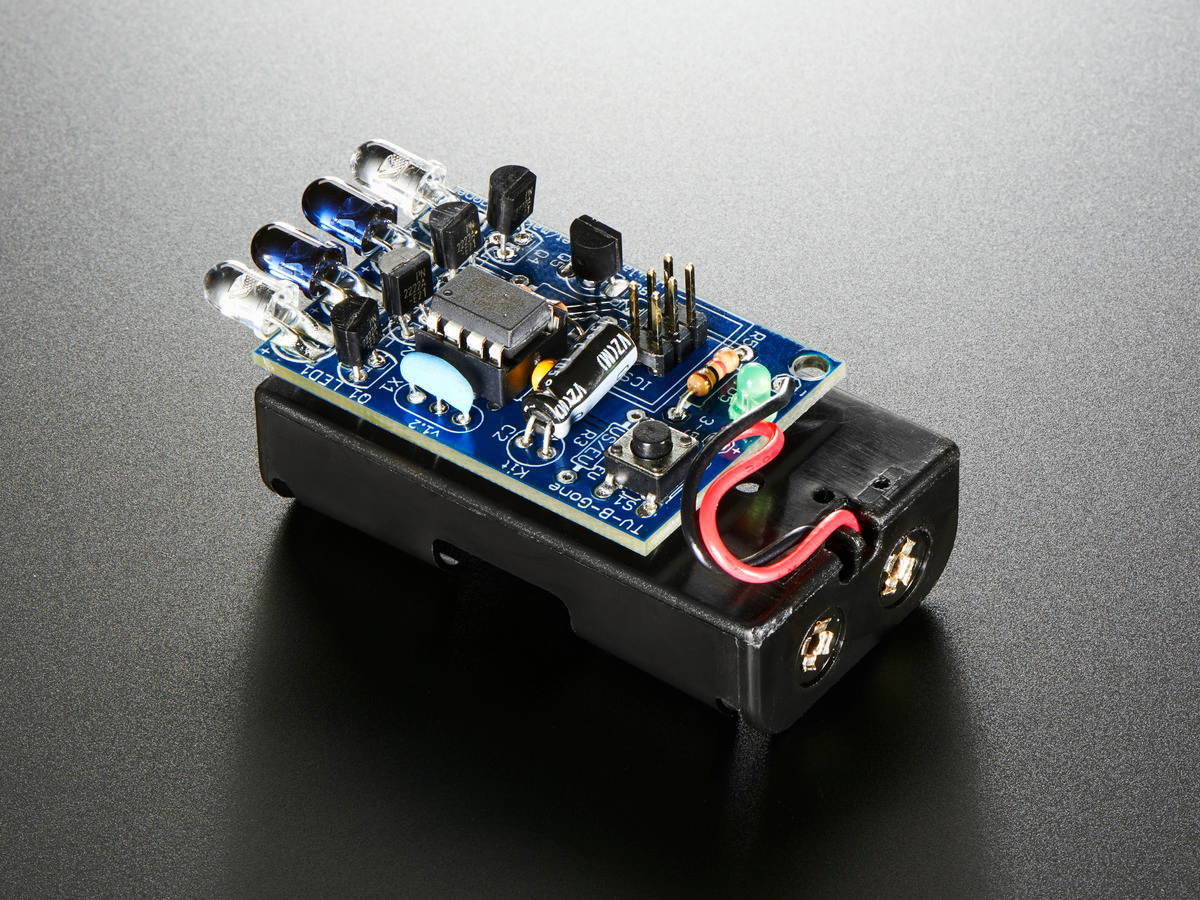
TV-B-Gone Kit
When we were putting together the TV-B-Gone kit, we started imagining a dystopian future, filled with televisions, where this kit would be super useful and we'd be a hero for having one. And while maybe that's dramatic, the TV-B-Gone is perfect for playing pranks on your friends during the Super Bowl or getting some peace and quiet during dinner. The TV-B-Gone is a kit that, when soldered together, allows you to turn off almost any television within 150 feet or more. It works on over 230 total power codes - 115 American/Asian and another 115 European codes. You can select which zone you want during kit assembly. This is an unassembled kit which means that soldering is required - but it’s very easy and a great introduction to soldering in general. The kit’s powered by 2x AA batteries - that aren’t included - and the output comes from 2x narrow beam IR LEDs and 2x wide-beam IR LEDs. The TV-B-Gone covers almost any television from the brands listed below, including the latest flat-screens and plasma TVs. There’s also lots more info on the TV-B-Gone website. And now for the brands! Acer, Admiral, Aiko, Alleron, Anam National, AOC, Apex, Baur, Bell & Howell, Brillian, Bush, Candle, Citizen, Contec, Cony, Crown, Curtis Mathes, Daiwoo, Dimensia, Electrograph, Electrohome, Emerson, Fisher, Fujitsu, Funai, Gateway, GE, Goldstar, Grundig, Grunpy, Hisense, Hitachi, Infinity, JBL, JC Penney, JVC, LG, Logik, Loewe, LXI, Majestic, Magnavox, Marantz, Maxent, Memorex, Mitsubishi, MGA, Montgomery Ward, Motorola, MTC, NEC, Neckermann, NetTV, Nikko, NTC, Otto Versand, Palladium, Panasonic, Philco, Philips, Pioneer, Portland, Proscan, Proton, Pulsar, Pye, Quasar, Quelle, Radio Shack, Realistic, RCA, Samsung, Sampo, Sansui, Sanyo, Scott, Sears, SEI, Sharp, Signature, Simpson, Sinudyne, Sonolor, Sony, Soundesign, Sylviana, Tatung, Teknika, Thompson, Toshiba, Universum, Viewsonic, Wards, White Westinghouse, Zenith
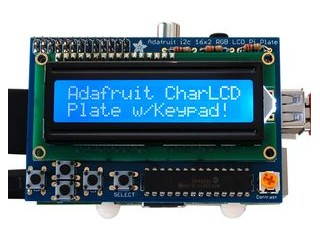
ADAFRUIT INDUSTRIES 1115 BLUE & WHITE 16X2 LCD + KEYPAD KIT, RASPBERRY PI
Accessory Type:LCD + Keypad Kit.Accessory Type:LCD + Keypad Kit.Features:Blue & White, 16 x 2.Features:Blue & Whi.For Use With:Raspberry Pi.For Use With:Raspberry Pi.RoHS Compliant:NA.SVHC:To Be Advised
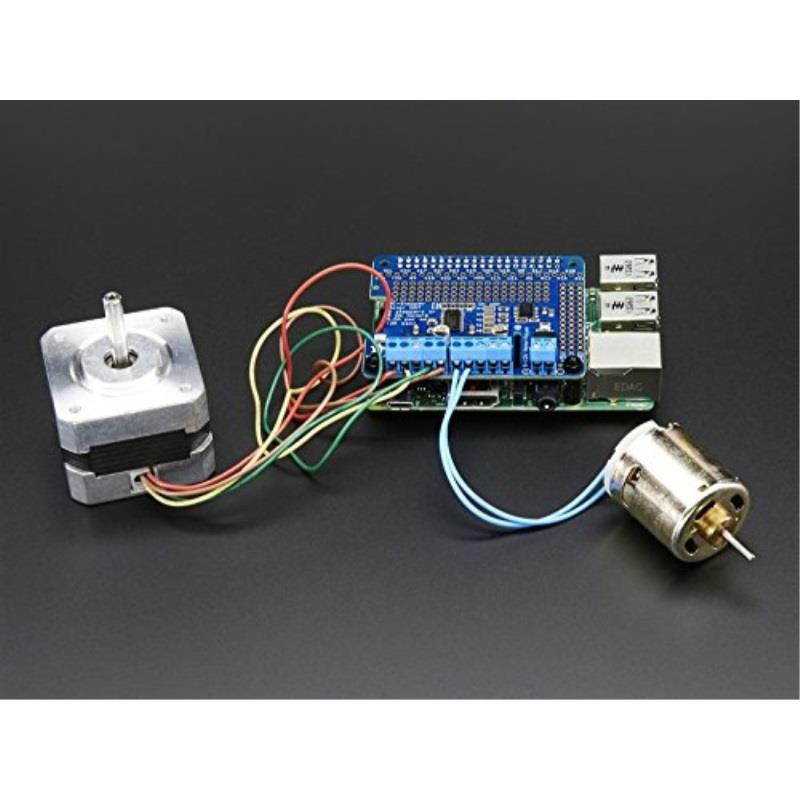
Adafruit DC & Stepper Motor HAT for Raspberry Pi - Mini Kit
Let your robotic dreams come true with the new DC+Stepper Motor HAT from Adafruit. This Raspberry Pi add-on is perfect for any motion project as it can drive up to 4 DC or 2 Stepper motors with full PWM speed control. Since the Raspberry Pi does not have a lot of PWM pins, we use a fully-dedicated PWM driver chip onboard to both control motor direction and speed. This chip handles all the motor and speed controls over I2C. Only two pins (SDA & SCL) are required to drive the multiple motors, and since it's I2C you can also connect any other I2C devices or HATs to the same pins. In fact, you can even stack multiple Motor HATs, up to 32 of them, for controlling up to 64 stepper motors or 128 DC motors (or a mix of the two) - just remember to purchase and solder in a stacking header instead of the one we include. Motors are controlled by TB6612 MOSFET drivers with 1.2A per channel current capability (you can draw up to 3A peak for approx 20ms at a time), a big improvement over L293D drivers and there are built-in flyback diodes as well. We even had a little space so we added a polarity protection FET on the power pins and a bit of prototyping area. And the HAT is assembled and tested here at Adafruit so all you have to do is solder on the included 2x20 plain header and the terminal blocks. Install the easy-to-use Python library, check out the examples and you're ready to go! Comes with an assembled & tested HAT, terminal blocks, and 2x20 plain header. Some soldering is required to assemble the headers onUPC:711978444085SKU:ADIB00TIY5JM8
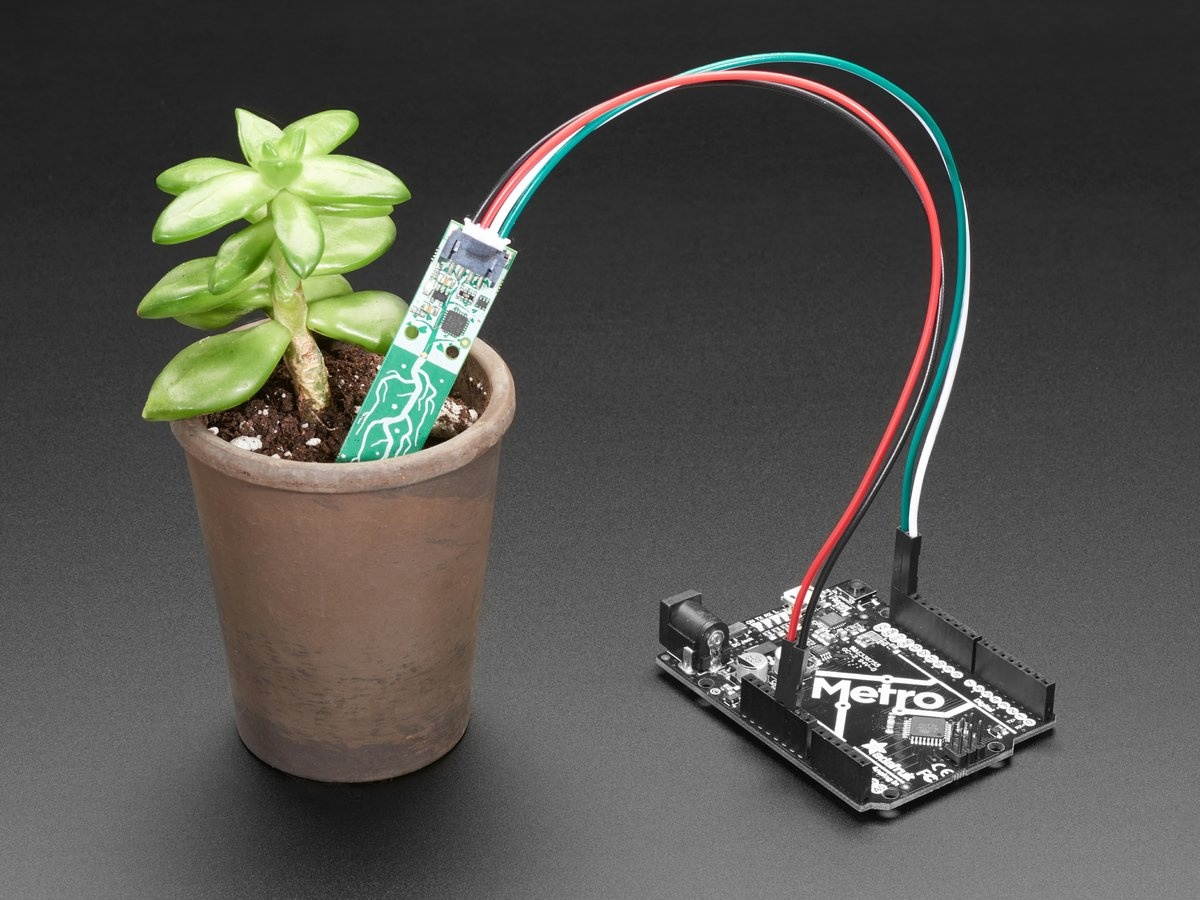
Adafruit STEMMA Soil Sensor - I2C Capacitive Moisture Sensor
Key Features: Updated in early 2020 to give a better range of values from soil moisture sensing I2C interface Determine your soil moisture via innovative capacitive measurement instead of resistive! No longer worry about your sensor oxidizing requiring repetitive re-calibration Most low cost soil sensors are resistive style, where there's two prongs and the sensor measures the conductivity between the two. These work OK at first, but eventually start to oxidize because of the exposed metal. Even if they're gold plated! The resistivity measurement goes up and up, so you constantly have to re-calibrate your code. Also, resistive measurements don't always work in loose soil. This design is superior with a capacitive measurement. Capacitive measurements use only one probe, don't have any exposed metal, and don't introduce any DC currents into your plants. Adafruit uses the built in capacitive touch measurement system built into the ATSAMD10 chip, which will give you a reading ranging from about 200 (very dry) to 2000 (very wet). As a bonus, you see the ambient temperature from the internal temperature sensor on the microcontroller, it's not high precision, maybe good to + or - 2 degrees Celsius. To make it so you can use the sensor with just about any microcontroller, Adafruit added an I2C interface. Connect a 4-pin JST-PH cable (not included) to your microcontroller or single board computer to 3-5V power, Ground, I2C SDA and I2C SCL and load the code. No soldering required. Item Specifics Size: 3.0 x 0.6 x 0.3 Weight: 4.0 g
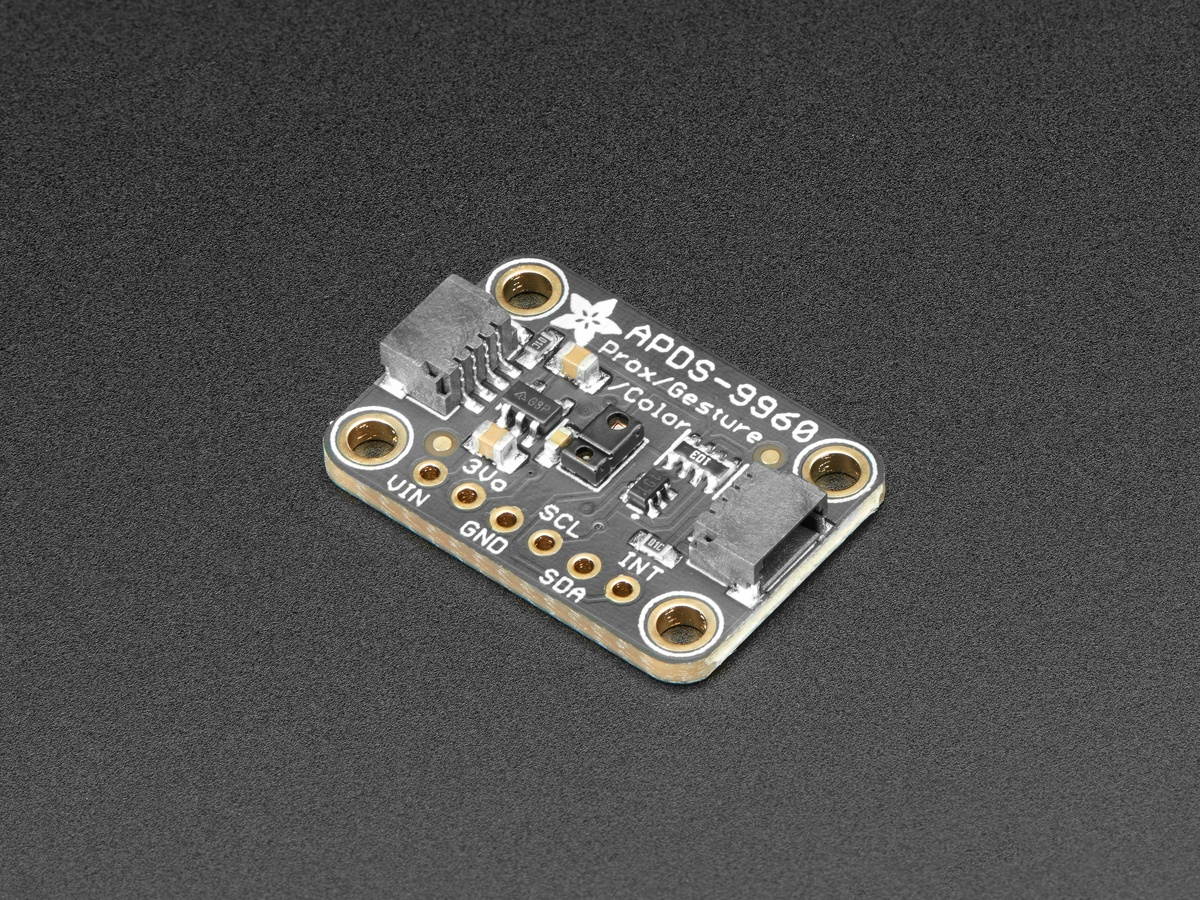
Adafruit APDS9960 Proximity, Light, RGB, and Gesture Sensor
Key Features: Add basic gesture sensing, RGB color sensing, proximity sensing, or ambient light sensing to your project Integrated IR LED and driver, along with four directional photodiodes sense reflected IR energy from the LED Measure the distance an object is from the front of the sensor (up to a few centimeters) with 8-bit resolution Detects simple gestures (left to right, right to left, up to down, down to up are currently supported) This breakout is chock full o & apos; sensors! Add basic gesture sensing, RGB color sensing, proximity sensing, or ambient light sensing to your project with the Adafruit APDS9960 Proximity, Light, RGB, and Gesture Sensor. When connected to your microcontroller (running our library code) it can detect simple gestures (left to right, right to left, up to down, down to up are currently supported), return the amount of red, blue, green, and clear light, or return how close an object is to the front of the sensor. This device uses an I2C interface so it & apos; s easy to wire up and use. The APDS9960 from Avago Technologies has an integrated IR LED and driver, along with four directional photodiodes that sense reflected IR energy from the LED. Its proximity detection feature allows it to measure the distance an object is from the front of the sensor (up to a few centimeters) with 8-bit resolution. For your convenience, Adafruit placed the sensor on a PCB with a 3.3V regulator and some level shifting so it can be easily used with your favorite 3.3V or 5V microcontroller. SparkFun qwiic compatible STEMMA QT connectors are built - in for the I2C bus so you don & apos; t even need to solder! Just wire up to your favorite microcontroller or computer with a plug-and-play QT cable to light/color/proximity data ASAP. Item Specifics QT cable not included
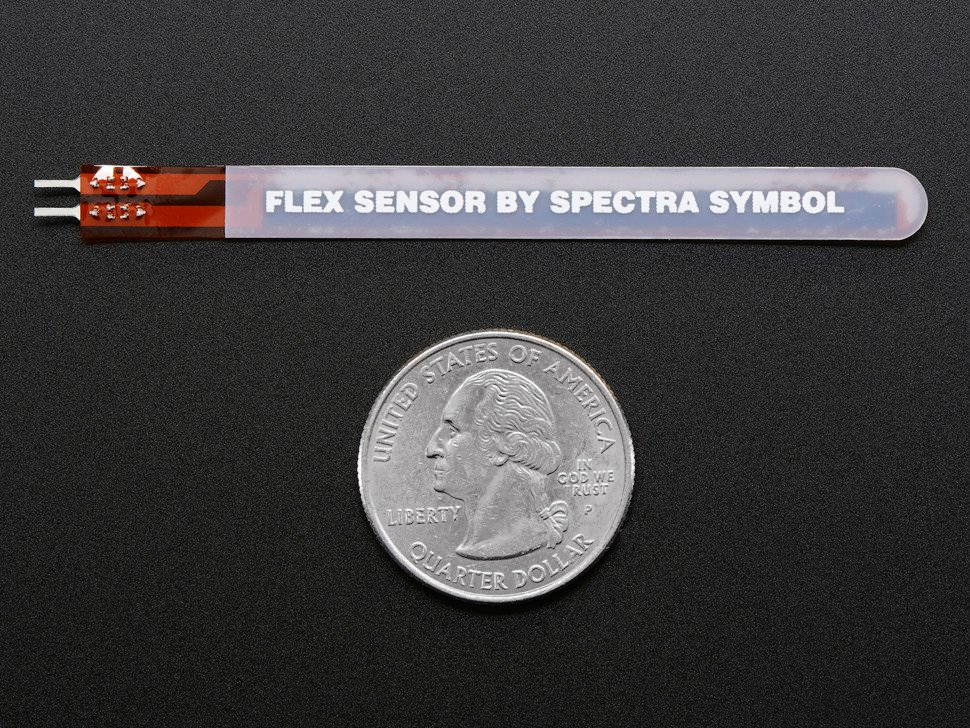
Adafruit 1070 Short Flex Sensor
This sensor can detect flexing or bending in one direction. They were popularized by being used in the Nintendo PowerGlove as a gaming interface. These sensors are easy to use, they are basically resistors that change value based on how much their flexed. If they're unflexed, the resistance is about ~25KO. When flexed all the way the resistance rises to ~100KO. They're pretty similar to FSRs so following this tutorial will get you started. You can use an analog input on a micro-controller (with a pullup resistor) or a digital input with the use of a 0.1 uF capacitor for RC timing. The bottom part of the sensor (where the pins are crimped on) is very delicate so make sure to have strain relief - such as clamping or gluing that part so as not to rip out the contacts!
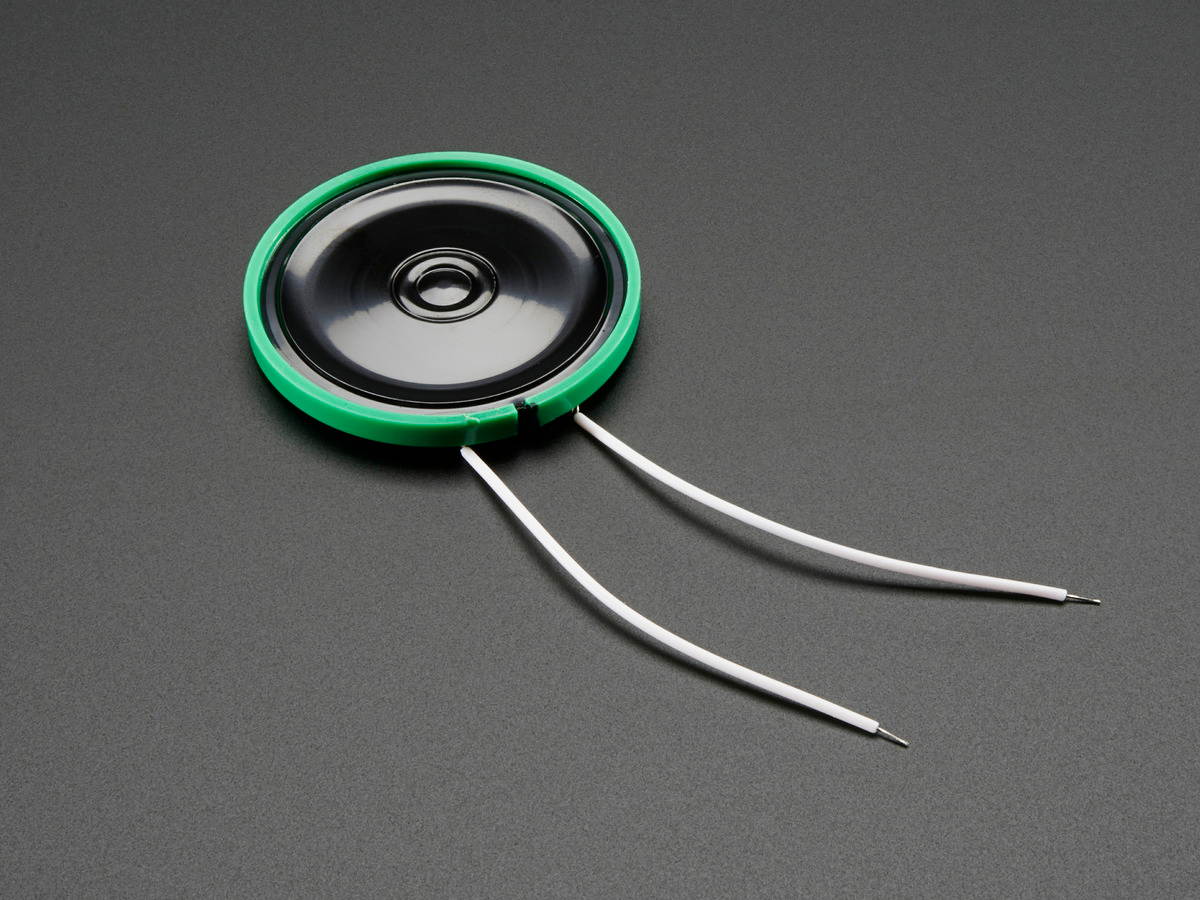
Adafruit Thin Plastic Speaker w/Wires - 8 ohm 0.25W
Key Features: Perfect addition to any audio project 8 & Omega; impedance and 0.25W of power Originally designed for & #39; talking & #39; greeting cards Very simple, plastic body is extremely lightweight and thin Listen up! This 1.5" diameter speaker cone is the perfect addition to any audio project where you need an 8 & Omega; impedance and are using 0.25W of power. The speakers are rated at 0.25W, with a maximum input of 0.5W (printed wattage on back of speaker may have either value). We particularly like this cone as it & #39; s very simple and its plastic body is extremely lightweight and thin. Originally designed for & #39; talking & #39; greeting cards, its fairly loud yet lightweight. Works great with Adafruit & #39; s Wave shield or class D amplifier board. Just be careful not to overdrive the speaker as high volumes can blow it out! Start with lower volume and increase carefully. Item Specifics Resonant Frequency: 440 & plusmn; 20% HZ Impedance: 8 ohm & plusmn; 15% at 1500HZ Rated Input Power: 0.25 W Maximum Input Power: 0.5W - printed wattage on back of speaker may have either value Frequency Range: 440~20KHz Diameter: 39mm / 1.5" Weight: 4.6 g
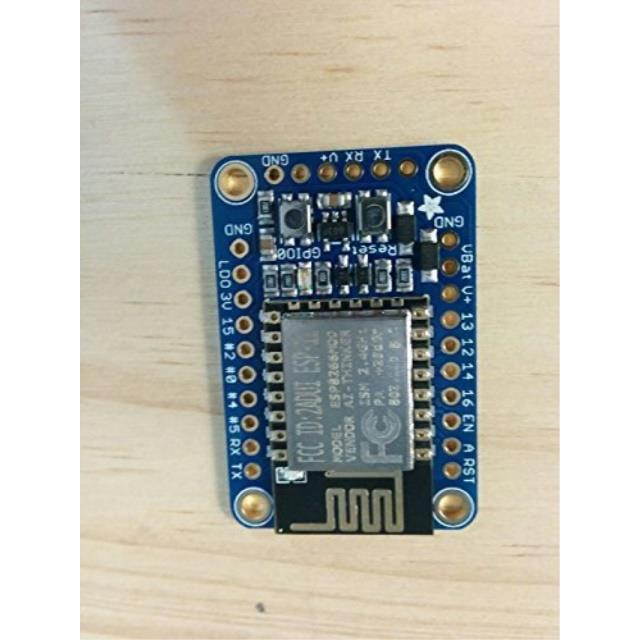
adafruit wifi / 802.11 development tools huzzah esp8266 breakout 1 piece
Add Internet to your next project with an adorable, bite-sized WiFi microcontroller, at a price you like! The ESP8266 processor from Espressif is an 80 MHz microcontroller with a full WiFi front-end (both as client and access point) and TCP/IP stack with DNS support as well. While this chip has been very popular, its also been very difficult to use. Most of the low cost modules are not breadboard friendly, don't have an onboard 500mA 3.3V regulator or level shifting, and aren't CE or FCC emitter certified....UNTIL NOW! The Adafruit HUZZAH ESP8266 breakout is what we designed to make working with this chip super easy and a lot of fun. We took a certified module with an onboard antenna, and plenty of pins, and soldered it onto our designed breakout PCBs. We added in: Reset button, User button that can also put the chip into bootloading mode, Red LED you can blink, Level shifting on the UART and reset pin, Two diode-protected power inputs (one for a USB cable, another for a battery) Two parallel, breadboard-friendly breakouts on either side give you access to: 1 x Analog input (1.8V max) 9 x GPIO (3.3V logic), which can also be used for I2C or SPI 2 x UART pins 2 x 3-6V power inputs, reset, enable, LDO-disable, 3.3V output Each order comes with one assembled and tested HUZZAH ESP8266 breakout board, and a stick of 0.1" header that you can solder on and plug the breakout into a breadboard. A soldering iron and solder are required for that, and aren't included. Solderless breadboard also not included. You'll really want a USB-serial cable such as a USB console cable (good for Windows, not suggested for MacOSX users), FTDI Friend (great for any OS), or FTDI cable (great for any OS) to upload software to the HUZZAH ESP8266!UPC NO:717520030263 SKU:ADIB0131V0WYI